
What causes a blocked drain
Your drains carry everything that leaves the house: water from the sink, bath, shower and washing machine, and whatever goes down the toilet. A blockage is anything that stops that flow. Most are caused by what we put down them. Fat, oil and grease poured away hot and left to set is the biggest culprit in UK homes, and wet wipes, which do not break down the way toilet paper does, are not far behind. Hair, soap scum, sanitary products and nappies finish the job. Outside, leaves, silt and tree roots add to it.
In the older terraces around Blackburn, Darwen, Accrington and Oswaldtwistle there is another factor. Many streets share a drain that runs under the back alley, so a blockage can start in someone else's property and show up in yours. Who clears it, and who pays, depends on where it sits. Our guide to drain responsibility explains the rules.
Signs to look out for
A drain rarely blocks without warning. These are the early signs, and the sooner you act on them the simpler the fix tends to be:
- Sinks, baths or showers draining slowly
- Gurgling from a plughole or the toilet when something else drains
- A toilet that flushes weakly, or water rising towards the rim
- Water backing up in a gully or around a manhole outside
- A smell of sewage in the house or garden
- More than one fixture affected at once, which usually points to the main drain rather than a single trap
How we clear it
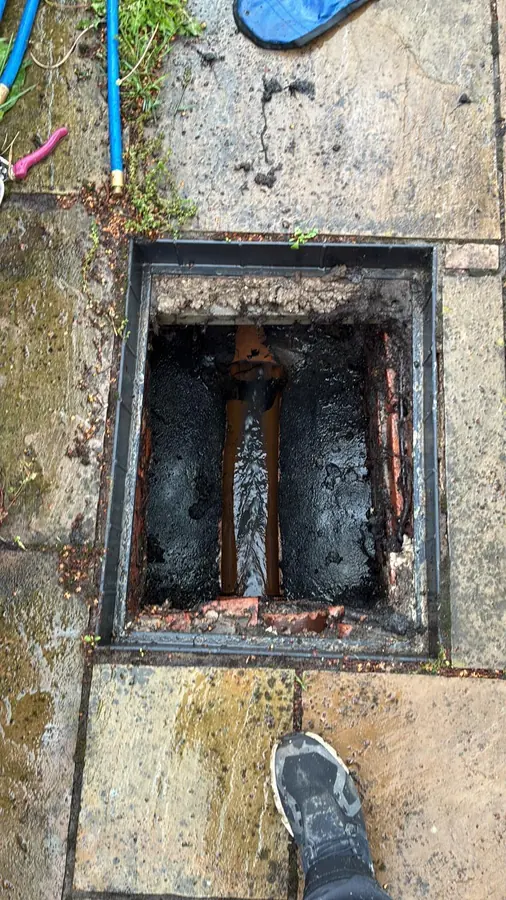
We start by working out where the blockage is. Running water through different fixtures, and checking the gully and the nearest chamber, usually tells us whether it is a single branch or the main run. Then we use the method that suits the pipe: drain rods for a soft blockage close to an access point, or high-pressure water when it is grease, scale or silt built up along the pipe wall (see drain jetting).
Once it is clear we run water through to check it flows freely end to end. If the blockage looks like a symptom, such as roots, a broken joint or a pipe that has dropped, we say so and suggest a camera survey (CCTV drain surveys) rather than clearing it again and again. A drain that blocks more than once or twice a year has a reason, and finding it is better than paying for repeat call-outs.


What affects the price
We would rather tell you straight than guess down a phone line, because the price depends on the job in front of us. The main things that change it are where the blockage is and how easy it is to reach (a clear chamber in the front garden is a different job to one buried under a patio), how long and how hard the blockage is, whether jetting is needed instead of rods, whether a camera is needed to find the cause, and whether it is an out-of-hours emergency. Once we have seen the problem you get a firm price before any work starts, so there are no surprises afterwards.
What happens after you call
You speak to the team. Tell us what is happening, where, and whether anything is coming up inside the house, and we will tell you whether it sounds like an emergency and when we can get a van to you. On site we find the blockage, explain what we have found and what it will cost, and clear it once you are happy. Before we go we check the flow and tell you what caused it and how to stop it coming back.